
What happened

Illustration: RivCut
Reuters reported April 16 that U.S. manufacturing output dropped in March following two consecutive months of solid increases. The decline surprised economists who had projected continued growth. Motor vehicle production accounted for a significant portion of the downturn, but the weakness extended beyond automotive to other product categories as well. This slowdown indicates that the recovery of the industrial sector is still bumpy and slow.
The Federal Reserve's industrial production index, which tracks output from factories, mines, and utilities, showed manufacturing declining after posting back-to-back gains in January and February. While the Fed release didn't specify exact percentage drops, the reversal marks a clear shift from the previous quarter's trajectory. Production data for durable goods manufacturing — the segment that includes aerospace machining and precision components — showed particular volatility across subcategories. Economists are watching this data to see if the drop will continue into the next quarter.
Capacity utilization rates, which measure how much of the nation's industrial infrastructure is actively producing goods, also softened. Lower utilization typically indicates manufacturers are operating with more slack than optimal, either because orders have slowed or because they're being cautious about ramping production in an uncertain demand environment. When factories operate with more slack, it can lead to lower profits and fewer hours for workers.
Why it matters for manufacturers

Illustration: RivCut
March's pullback exposes something procurement teams already know: demand isn't recovering uniformly. Auto OEMs cutting production runs create ripple effects through their supply chains, from stampings to fasteners to the CNC parts that go into assembly tooling. When a Tier 1 supplier sees its forecast drop 8%, machine shops feel it two weeks later in revised PO quantities. This makes it very hard for small suppliers to manage their inventory and labor.
The timing complicates planning for the second quarter. Shops that staffed up in January and February based on strengthening order books now face the prospect of uneven workload distribution. That creates a dilemma: maintain capacity for customers who might ramp again in May, or scale back and risk longer lead times if orders rebound quickly. Neither option is cheap. Operating with idle machines and workers reduces cash flow, which is the lifeblood of small businesses.
For buyers sourcing machined components, this environment cuts both ways. Shops with open capacity might offer shorter lead times on new quotes, but the same uncertainty that's creating that capacity also increases the risk of supply chain disruptions if smaller suppliers exit the market. A subcontractor who built up inventory in February expecting sustained demand may now be sitting on raw material they can't move, straining cash flow. That's the kind of stress that closes 10-person job shops without much warning.
The other risk is quality drift. When shops chase declining volumes by taking on unfamiliar work outside their core competencies, reject rates tend to climb. A supplier who normally machines aluminum brackets suddenly quoting stainless valve bodies is a red flag. Rigorous CMM inspection and QA protocols become even more critical when manufacturers are stretching to fill capacity. Buyers must verify that their suppliers are not cutting corners to save money.
Capacity utilization data will be particularly important to watch through May and June. If utilization stays soft, material suppliers may start adjusting inventory levels downward, which could mean longer lead times on everything from bar stock to tooling inserts later in the year when demand does pick back up.
The Shift in Domestic Production
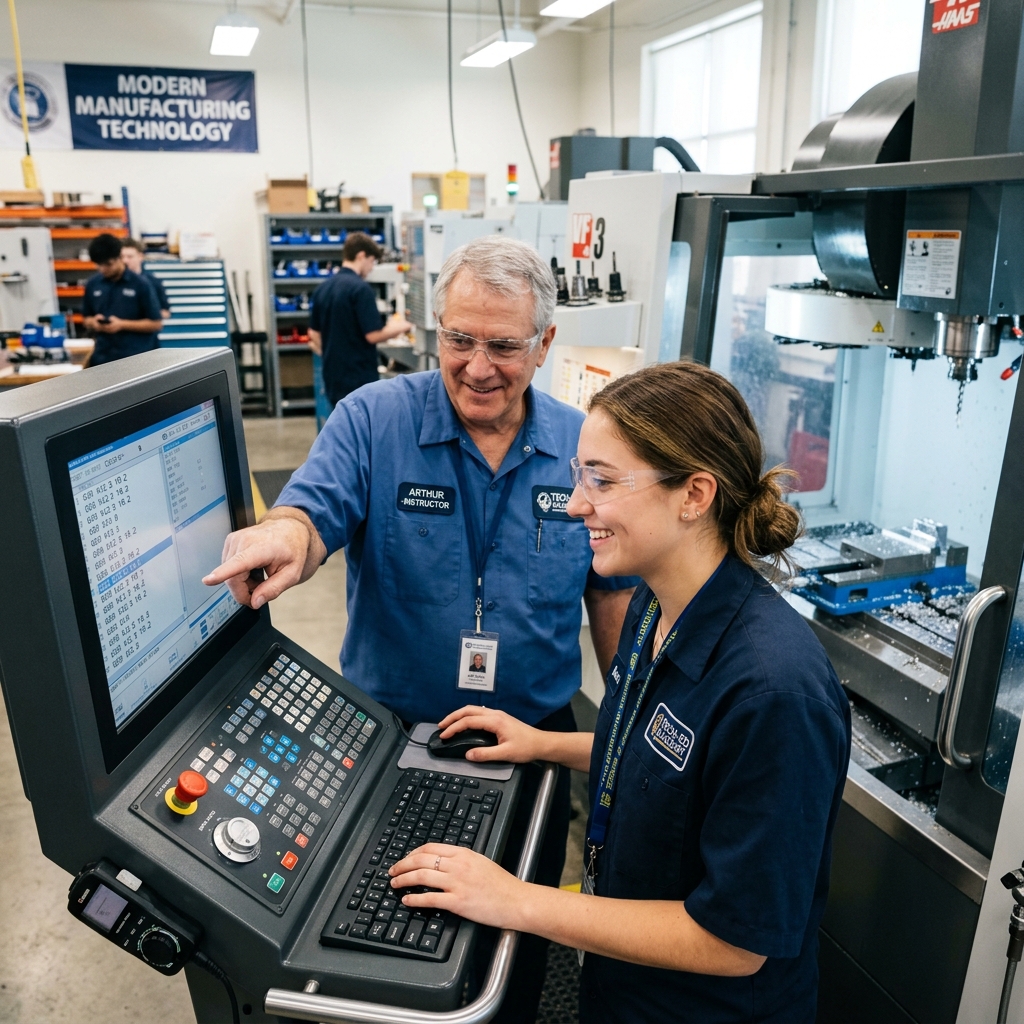
Illustration: RivCut
American manufacturers are trying to bring their production back home. This reshoring effort is driven by supply chain problems and rising global shipping costs. Over the past few years, shipping parts across the ocean has become slow and expensive. Port delays can hold up production lines for weeks. By sourcing parts from local shops, companies can get them much faster. This makes their operations more flexible and reliable.
However, reshoring requires a strong network of local machine shops. These shops must be able to produce high-quality parts at competitive prices. They must also have access to raw materials and skilled labor. The transition is not easy, and it takes time to set up new supply chains. But the long-term benefits are clear: more jobs in the United States and a more stable economy that is less vulnerable to global disruptions.
Local manufacturing also allows for better communication between buyers and suppliers. Engineers can easily visit a local shop to check on progress or discuss design changes. This close collaboration leads to better quality and fewer errors. It also helps shops react quickly when the buyer needs to change their order quantities. A strong domestic supply chain is critical for national security and economic growth.
Advancements in Manufacturing Technology
New technologies are changing the way factories operate. Automation and robotics are helping manufacturers improve efficiency and quality. In many plants, robots handle repetitive and heavy tasks. This keeps human workers safe and reduces errors. It also allows factories to run continuously, even when labor is scarce. Automation is no longer just for large companies; smaller machine shops are also adopting these tools.
Precision machining technology has also advanced. Modern CNC machines can hold tolerances as tight as a few ten-thousandths of an inch. These machines are controlled by computer programs, which ensures that every part is identical. This level of precision is needed for critical applications like medical implants, aerospace systems, and high-performance engines. It reduces waste and ensures that parts perform reliably in the field.
In addition, digital inspection systems have become standard. Coordinate measuring machines can verify the dimensions of a part in seconds. They create digital records that prove the part meets the customer's specifications. This traceability is essential for industries with strict quality rules. By investing in these technologies, American shops can compete with low-cost suppliers overseas on both quality and speed.
What to watch next
April's production data, due in mid-May, will show whether March was an aberration or the start of a longer slowdown. If auto production stays weak into spring, expect component suppliers to get more aggressive on pricing for non-automotive work. Shops that depend heavily on automotive customers will be looking to diversify fast.
Watch for inventory adjustments at distributors. When manufacturing output contracts, metal service centers and industrial suppliers typically start drawing down stock within 60 days. That lag means the supply impact of March's decline might not show up until late May or early June. Buyers who wait until they see longer material lead times to adjust their planning will already be behind.
The other variable is whether this softness spreads beyond motor vehicles into other durable goods categories. Defense and aerospace production has remained relatively stable, but commercial aviation component demand is always vulnerable to broader economic uncertainty. If March's weakness was concentrated in consumer-adjacent manufacturing, that's one thing. If it shows up across industrial categories in April's numbers, that's a different planning problem entirely. Check back at RivCut's manufacturing news coverage as Q2 data develops.
For more analysis on how US manufacturing output affects precision machining and supply chains, visit our manufacturing news section.
Frequently Asked Questions (FAQ)
Why did U.S. manufacturing output fall in March?
Answer: U.S. manufacturing output fell because motor vehicle production went down. Other industrial sectors also showed weakness after two months of gains.
How does a decline in car production affect smaller machine shops?
Answer: Car production drops create a ripple effect. When large suppliers see lower orders, they reduce their purchase orders for metal parts and tooling from smaller shops.
What is the main risk of uneven manufacturing demand?
Answer: The main risk is that shops face unstable workloads. This makes it hard to hire workers and can lead to financial trouble for small suppliers.
Why is quality control important during a manufacturing slowdown?
Answer: During a slowdown, shops may take on new and unfamiliar jobs to fill capacity. This can lead to more mistakes, so strict inspection is needed.
When a Tier 1 supplier sees its forecast drop 8%, machine shops feel it two weeks later in revised PO quantities.