
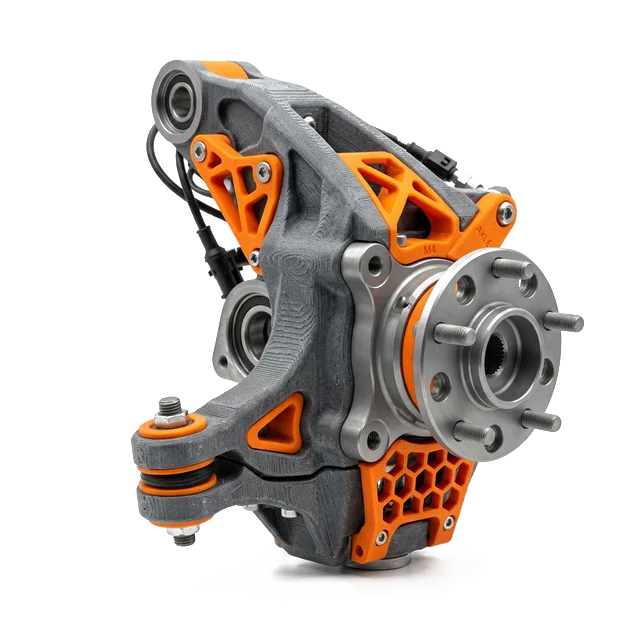

What Is a Prototype?
A prototype is the first physical version of a product or part — built to test form, fit, and function before you commit to production tooling and volume manufacturing. In CNC machining, a prototype is cut from real production materials on the same machines that will make your final parts. This means your prototype behaves exactly like the production version: same strength, same tolerances, same surface finish. Unlike 3D prints that warp, shrink, and use surrogate materials, a CNC prototype gives you ground truth about how your design actually performs.
Validate Form & Fit
Check that your part interfaces correctly with mating components, enclosures, and assemblies before committing to tooling.
Test Real-World Function
Load test, thermal test, and destructive test your prototype in the actual material. Get data you can trust for design decisions.
De-Risk Production
Catch design issues before they become expensive production problems. A $200 prototype can save $20,000 in tooling rework.
Why Prototype with CNC Machining?
CNC machining is the gold standard for functional prototypes. Here are four reasons engineers choose CNC over 3D printing, casting, or sheet metal for prototype development.
Real Production Materials
Your prototype is machined from the same aluminum, stainless steel, titanium, or engineering plastic as your production part. No surrogate materials, no approximations. The mechanical properties, thermal behavior, and surface finish of your prototype match what customers will receive. This is critical for load-bearing components, FDA submissions, and any application where material properties matter.
Production-Grade Tolerances
CNC prototypes hold ±0.001" on critical features — the same tolerances you will specify in production. 3D printed prototypes typically hold ±0.010" at best and degrade with layer lines, warping, and anisotropic shrinkage. When your prototype needs to interface with bearings, seals, mating parts, or optical assemblies, CNC is the only method that gives you reliable dimensional data.
Fast Iteration Cycles
CNC prototypes ship in 1 to 5 business days. There is no tooling to build, no molds to modify. Change a dimension in your CAD file, upload the new version, and get a revised prototype in days. Most engineering teams go through 3 to 5 design iterations before locking in — CNC makes each cycle fast and affordable.
Same-Shop Production Scaling
When your prototype is validated, scaling to 50, 500, or 5,000 parts happens on the same machines with the same programs. There is no re-qualification, no tooling transfer, and no dimensional shift between prototype and production. Your setup programs, fixture designs, and inspection routines carry over directly — saving weeks of ramp-up time.
The Prototyping Process: Design to Delivered Part
Five steps from your CAD file to a physical prototype in your hands. No runaround, no surprises.
Design Your Part
Create your 3D model in SolidWorks, Fusion 360, or any CAD software. STEP files are ideal but we accept IGES, STL, and PDF drawings too. Do not have a finished design? That is fine — we work with preliminary models.
Upload Your File
Upload your CAD file on our quoting platform. Select your material, quantity, and surface finish. You will receive a detailed quote within hours — not days. One part is fine. No phone call required.
Free DFM Review
Our engineers review your design for manufacturability. We flag thin walls, undercuts, and tolerance callouts that could increase cost or lead time — and suggest alternatives. This review is free on every order.
CNC Machining
Your prototype is CNC machined from solid bar or plate stock. We program toolpaths, set up fixtures, and cut your part on precision 3-axis and 4-axis mills. Every part is CMM inspected before it leaves our facility.
Ship & Iterate
Your prototype ships with dimensional inspection data and material certifications. Test it, identify changes, upload a revised file, and get the next iteration in days. When you are ready for production, we scale up with the same tooling and programs.
Top 10 Materials for Prototyping
We stock 50+ metals and plastics. These are the ten most popular materials for prototype projects, chosen for machinability, cost, and mechanical performance.
Aluminum 6061-T6
The most popular prototype material. Affordable, machines fast, good strength-to-weight ratio. Ideal for enclosures, brackets, and structural parts. Anodizes well for a finished look.
Most popularAluminum 7075-T6
High-strength aluminum for aerospace and defense prototypes. Nearly twice the yield strength of 6061. Choose this when your prototype must survive structural load testing or fatigue cycles.
High strengthStainless Steel 304
The standard corrosion-resistant prototype material. Great for food contact, medical devices, and outdoor applications. Machines slower than aluminum but offers superior chemical resistance.
Corrosion resistantStainless Steel 316
Medical-grade stainless with superior corrosion resistance in saline and chemical environments. Required for surgical instruments, implant test samples, and marine applications.
Medical gradeTitanium Grade 5 (Ti-6Al-4V)
Highest strength-to-weight ratio of any machinable metal. Essential for aerospace brackets, medical implants, and weight-critical prototypes. Biocompatible and corrosion-proof.
Aerospace & medicalBrass 360
Excellent machinability for complex prototype geometries with fine features. Naturally antimicrobial, good electrical conductivity. Popular for connectors, fittings, and decorative hardware.
Easy to machineDelrin (Acetal / POM)
The go-to engineering plastic for prototype gears, bushings, and sliding mechanisms. Low friction, excellent dimensional stability, and easy to machine to tight tolerances. Self-lubricating.
Low friction plasticPEEK
High-performance engineering plastic for extreme temperature and chemical environments. FDA-compliant, sterilizable, and incredibly strong. Used for medical devices, semiconductor fixtures, and aerospace components.
High performanceNylon 6/6
Tough, wear-resistant plastic for functional prototype housings, snap-fit clips, and cable management components. Good impact resistance and chemical compatibility. Machines cleanly at tight tolerances.
Tough & wear-resistantCopper C110
Pure copper for thermal management prototypes, heatsinks, and electrical bus bars. Highest thermal and electrical conductivity of any machinable metal. Essential for power electronics and RF applications.
Thermal managementPrototype vs. Production: Key Differences
Understanding the differences between prototype and production machining helps you plan timelines, budgets, and design iterations.
| Factor | Prototype | Production |
|---|---|---|
| Quantity | 1–10 pieces | 50–5,000+ pieces |
| Lead Time | 1–5 business days | 2–6 weeks |
| Unit Cost | Higher (no volume discount) | Lower (amortized setup) |
| Design Changes | Expected & easy | Costly & disruptive |
| Tooling | Standard tooling, no fixtures | Custom fixtures for repeatability |
| Inspection | CMM first article inspection | SPC + in-process gauging |
| Goal | Validate design & test function | Consistent, repeatable output |
| Documentation | Inspection report + material cert | PPAP, FAI, CoC, lot traceability |
The good news: when you prototype with RivCut, your transition to production is seamless. Same machines, same programs, same quality standards. No re-qualification needed.

How to Prototype a New Product
If you are making a prototype for the first time, this step-by-step approach will save you time, money, and frustration. Thousands of hardware startups, medical device companies, and defense contractors follow this exact process.
a 3D model
material wisely
test pieces
& iterate
- Start with a 3D CAD model. Use SolidWorks, Fusion 360, or any parametric modeler. Even a preliminary design works — our DFM review catches issues before machining.
- Pick the right material early. Prototype in the same material you intend for production. Aluminum 6061 is the default for most mechanical prototypes. Use stainless for corrosion environments, Delrin for plastic mechanisms.
- Order 2 to 5 pieces. One for form/fit testing against mating parts. One for destructive testing (load, drop, thermal). One as a reference sample. Extra pieces let multiple team members test in parallel.
- Plan for 3 to 5 iterations. Almost no design is perfect on the first try. Budget for multiple rounds. Each iteration with CNC costs $65 to $500 and takes 1 to 5 days — far cheaper than discovering issues in production.
Prototype Cost Breakdown: What Drives Pricing
CNC prototype costs are straightforward once you understand the four main factors. Here is what determines whether your prototype costs $65 or $500+.
Material Cost
Material is typically 10 to 30 percent of prototype cost. Aluminum 6061 is the cheapest — roughly $3 to $8 per pound of bar stock. Titanium runs $25 to $60 per pound. PEEK is $80+ per pound. The material you choose directly impacts both raw material cost and machining time, since harder materials cut slower and consume more tooling.
Part Complexity
A simple 2D profile part with holes and pockets might take one setup and 15 minutes of machine time. A complex 3D contoured part with undercuts, thin walls, and tight internal radii could require 3 to 4 setups and 2+ hours. Each additional setup adds $30 to $75 in fixturing and programming time.
Tolerances & Surface Finish
Standard ±0.005" tolerances are included at no extra cost. Tightening to ±0.001" requires slower feeds, finer tools, and additional inspection time — adding 15 to 30 percent to the price. Mirror finishes (under 16 Ra) require secondary polishing operations.
Lead Time & Rush Fees
Standard 5 to 7 day turnaround is the baseline price. 3-day rush adds 20 to 40 percent. Same-day or next-day service (available for simple parts) carries a premium. If your timeline is flexible, standard lead time gives you the best per-part cost.
Upload your file and get exact pricing within hours. No phone call needed.
Common Questions About Prototypes
Related Prototyping Resources
Dive deeper into prototyping topics with these guides, tools, and comparisons.
Rapid Prototyping Services
Our core rapid prototyping page with full details on lead times, capabilities, and part types. See what ships in 3 days.
Service pagePrototype vs. Production Machining
An in-depth blog article comparing prototype and production machining: costs, timelines, tooling, and when to transition.
Blog articleCNC Cost Calculator
Estimate your prototype cost based on material, complexity, and quantity. Get a ballpark before uploading your CAD file.
Interactive toolTurn Your Design Into a Prototype
Upload your CAD file and get a quote within hours. One part or fifty. Rush delivery in as few as 3 days. Free DFM review on every order.
Free DFM review · NDA ready · Ships anywhere in the US