

What Is Swiss CNC Machining?
Swiss CNC machining (also known as Swiss screw machining or sliding headstock turning) feeds bar stock through a stationary guide bushing directly adjacent to the cutting tool. Because the material is supported right where the cut happens, deflection and vibration are eliminated — allowing ultra-tight tolerances, micro features, and length-to-diameter aspect ratios over 20:1 that conventional CNC lathes cannot achieve.
Bar Stock Feeds Through Guide Bushing
The raw bar feeds through a carbide-lined guide bushing, providing zero-clearance support right next to the cutting insert.
Sliding Headstock Moves Along Z-Axis
Instead of moving the cutting tool along the part, the headstock advances the bar past fixed gang tooling, maintaining maximum rigidity.
Live Tooling & Sub-Spindle Dual Machining
Cross-milling, axial drilling, threads, and back-side features are completed in a single setup before parting off the finished part.
Where Kansas City Engineering Talent Buys Its Turned Parts
Few metros concentrate this much precision electronics talent. The Kansas City National Security Campus, managed by Honeywell FM&T for the NNSA, produces some of the most tightly documented electromechanical assemblies in the country, and Garmin's Olathe headquarters employs thousands of engineers designing GPS units, avionics and wearables. Both institutions train people who go on to spec connector pins, contact pins and machined sensor packaging for programs across the metro, and both set documentation expectations that most job shops cannot meet.
Automotive adds volume to that precision base. Ford's Kansas City Assembly in Claycomo builds the F-150 and Transit, GM Fairfax runs across the river and Panasonic Energy's battery expansion is pulling EV component suppliers into the region. Tier suppliers feeding those lines buy fittings, standoffs and valve spools by the tens of thousands, exactly the volumes bar-fed Swiss turning was built for.
Swiss lathes fit this mix because the guide bushing supports the bar at the cutting point, so a long slender pin or shaft holds size end to end. One setup with live tooling and a sub-spindle turns, mills, cross-drills and parts off a finished component, which is how a run of 20,000 contact pins stays consistent from piece 1 to piece 20,000.
Engineered for Micro-Precision & High Volume
From single medical prototypes to automated 100,000+ piece production runs — built for zero defect manufacturing.
±0.0001" Micro Tolerance
Holding ultra-precise concentricity, diameter, and thread pitch tolerances on slender pins, shafts, and medical implants where standard lathes fail.
Single-Setup Completion
Multi-axis live tooling and sub-spindles handle turning, off-center milling, cross-drilling, hex broaching, and thread whirling with zero secondary setups.
Superior Ra 16 Surface Finish
Rigid guide bushing support eliminates chatter and micro-vibration, consistently producing mirror-smooth Ra 16 µin (0.4 µm) turned surfaces as-machined.
Lights-Out Production Savings
Automatic bar feeders and continuous chip management allow 24/7 un-attended operation, dramatically lowering unit costs for mid-to-high volume orders.
Swiss Machining Services Suite
Sliding headstock capabilities engineered for challenging small-diameter components.
Micro-Miniature Turning
Machining small-diameter components down to 0.020" (0.5 mm) with tight features, internal bores, and miniature threads for medical instruments and micro-valves.
Down to 0.5 mm barHigh L/D Ratio Slender Shafts
Turning long, slender shafts and pins with length-to-diameter ratios up to 20:1 without chatter, taper, or deflection.
L/D up to 20:1Multi-Axis Live Tooling
Up to 12 axes with motorized driven tools for off-center milling, keyways, cross-drilled passages, hex flats, and helical thread whirling.
Up to 12-axis liveDual-Spindle Sub-Machining
Synchronized pick-off sub-spindle finishes the back end of the part—chamfering, counterboring, and tapping—delivering 100% complete parts off the line.
100% finished partsMedical & Implant Machining
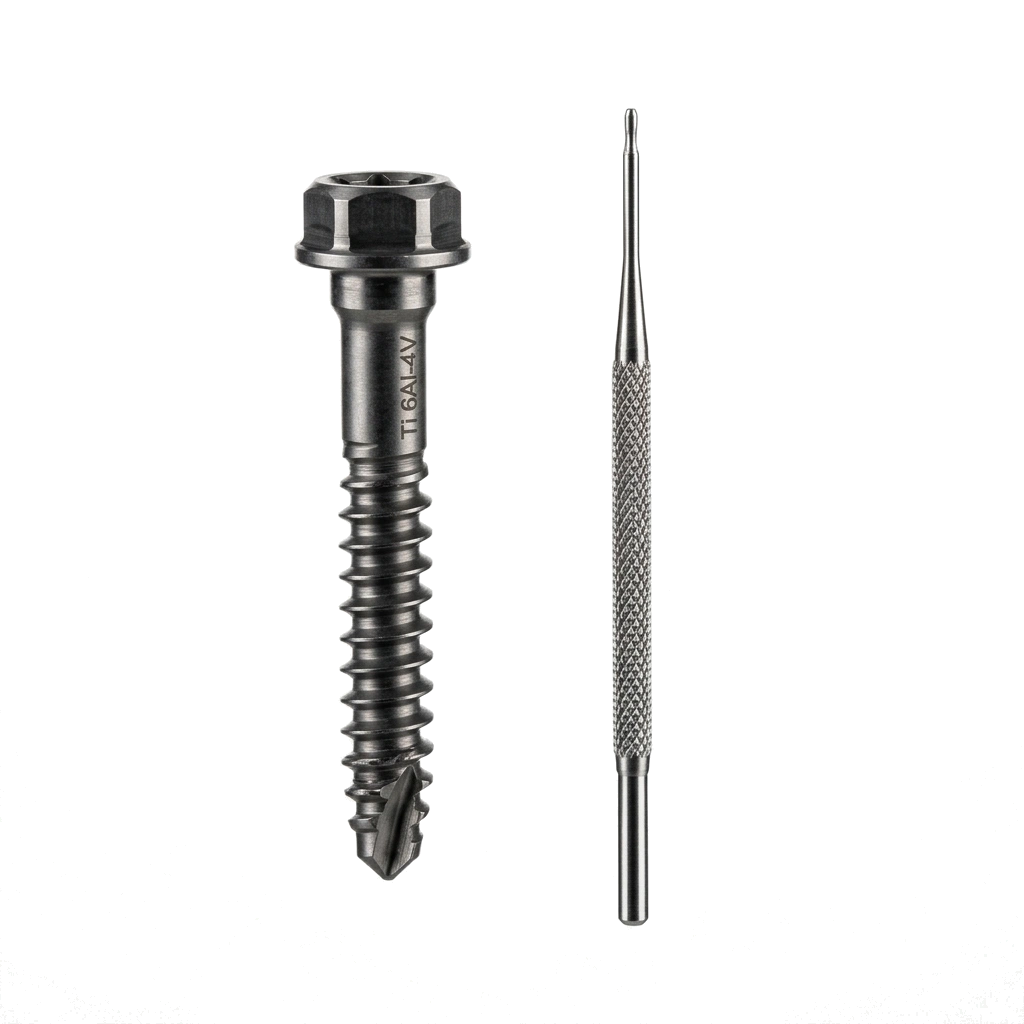
Precision turning of Titanium Ti-6Al-4V ELI bone screws, dental implant posts, orthopedic pins, and endoscope tips with ISO 13485 quality control.
Titanium & 316L medicalHigh-Volume Bar Fed Runs
Automated 12ft bar loaders, high-pressure coolant (2,000 PSI), and automated part catchers support fast production runs from 500 to 100,000+ pieces.
500 to 100,000+ pcs
Titanium Grade 5 Dental Implant Post & Bone Screw
Swiss turned for a medical device manufacturer requiring intricate thread geometry, micro-cannulation through-holes, and tight hex drive features. Machined in a single operation with zero hand deburring required.
tolerance held
surface finish
turnaround
2,500-piece run
- Optical comparator & CMM dimensional inspection report
- Mill test certs (EN 10204 3.1) with heat lot traceability
- Passivation certs per ASTM A967 / ASTM F86
- Certificate of Conformance per medical purchase order
Swiss Turning vs. Standard Lathe vs. CNC Milling
Choose the right manufacturing method based on geometry, tolerances, and batch size.
Stocked Materials for Swiss Turning
Precision ground round bar stock in metals, medical alloys, and engineering plastics.
Titanium Alloys
Ti-6Al-4V (Grade 5), Ti-6Al-4V ELI (Grade 23), Commercially Pure Titanium (Grade 2). Ideal for biocompatible implants, dental screws, and aerospace pins.
Stainless Steels
303, 304/304L, 316/316L, 17-4 PH, 440C, Custom 455. Excellent corrosion resistance, high tensile strength, and medical compliance.
Copper & Brass Alloys
C36000 Free-Cutting Brass, C17200 Beryllium Copper, Tellurium Copper C14500. Perfect for gold-plated electrical contacts and probe tips.
Specialty & Superalloys
Inconel 718, Kovar, Nitronic 60, Hastelloy C-276, Nitinol. High-temperature and controlled-expansion applications for aerospace and energy.
Medical Plastics
PEEK (Unfilled & 30% Glass Filled), Delrin (POM-H), PTFE (Teflon), Ultem 1000, Torlon 4203. Biocompatible, autoclavable, and dimensionally stable.
Alloy & Tool Steels
4140, 4340, A2, D2, M2 tool steel. High wear resistance and toughness after vacuum heat treating for mechanical shafts and dowels.
DFM Tips for Swiss Turned Parts
Optimize your 3D CAD models and drawings for maximum Swiss machining efficiency.
1. Precision Ground Bar Stock
Because the bar slides through a guide bushing, use h8 diameter tolerance precision ground bar stock to prevent binding or loose play.
2. Thread Relief Grooves
Provide a thread relief necking groove at thread shoulders (minimum 1.5x thread pitch) to allow clean single-point thread tool retraction.
3. Corner Radii & Chamfers
Specify internal corner radii of at least R 0.010" (0.25 mm) and external 45° lead-in chamfers to ease automated tool engagement and deburring.
Where Swiss Machining Fits in Kansas City
From prototypes to bar-fed production, this is Kansas City's Swiss workload.
Defense & National Security Electronics
The Kansas City National Security Campus anchors a supplier network that machines to standards well past commercial norms, and Whiteman AFB's B-2 wing adds sustainment demand across the region. Swiss turning covers the small end of that work: gold-plateable contact pins, connector bodies, precision standoffs and hermetic-ready feedthrough blanks in 303 and 316 stainless, beryllium copper and Kovar. RivCut runs these with full material traceability, first article inspection reports and ITAR-compliant handling, and we hold concentricity to 0.0002 inch TIR where connector stacks demand it.
Avionics & Aerospace
Garmin's Olathe campus and GE Aerospace's Overland Park operations sit minutes from downtown, and the Wichita aerostructures corridor is a morning's drive south. Avionics hardware leans on turned parts under 0.5 inch diameter: antenna mount pins, sensor housings with EMI-tight bores, instrument fasteners and shafts for rotary controls that need to feel precise over thousands of cycles. We Swiss machine these from 6061, 7075, 303 stainless and titanium with Ra 16 microinch as-machined finishes, so plating and anodize go on clean.
Automotive & EV
Ford Claycomo and GM Fairfax run multiple shifts, and their tier suppliers reorder the same turned parts every cycle: fuel fittings, brake system fittings, sensor bosses, dowels and valve spools. Panasonic Energy's regional battery buildout adds busbar standoffs and cell interconnect pins to the mix. Bar-fed Swiss runs of 500 to 100,000 plus pieces hold PPAP-friendly consistency because nothing gets re-fixtured between operations, and blanket-order pricing means a Kansas City buyer is not requoting a C-class part every quarter.
What Kansas City Engineers Ask Us
Everything Kansas City buyers ask before the first PO.
Swiss Machining Beyond Kansas City
Swiss Precision, Delivered to Kansas City
From first article to bar-fed production, quoting for Kansas City starts with one CAD upload.