

What Is Swiss CNC Machining?
Swiss CNC machining (also known as Swiss screw machining or sliding headstock turning) feeds bar stock through a stationary guide bushing directly adjacent to the cutting tool. Because the material is supported right where the cut happens, deflection and vibration are eliminated — allowing ultra-tight tolerances, micro features, and length-to-diameter aspect ratios over 20:1 that conventional CNC lathes cannot achieve.
Bar Stock Feeds Through Guide Bushing
The raw bar feeds through a carbide-lined guide bushing, providing zero-clearance support right next to the cutting insert.
Sliding Headstock Moves Along Z-Axis
Instead of moving the cutting tool along the part, the headstock advances the bar past fixed gang tooling, maintaining maximum rigidity.
Live Tooling & Sub-Spindle Dual Machining
Cross-milling, axial drilling, threads, and back-side features are completed in a single setup before parting off the finished part.
Turned Parts for the Research Triangle Supply Chain
One cluster shapes what Durham engineers buy from a Swiss shop. Research Triangle Park concentrates medical device and diagnostics work, with BD running injection and infusion device operations in RTP and Duke University Medical Center pulling device clinical trials into the region. The Duke-Coulter Translational Partnership pushes biomedical prototypes toward commercialization, and every one of those programs eventually needs cannulated screws, luer fittings, electrode bodies or instrument shafts machined in implant grade materials with lot traceability.
Semiconductors form the second layer of that supply chain. Wolfspeed develops silicon carbide power devices from its Durham headquarters, and IBM runs advanced packaging research at RTP, so local test labs burn through machined contact pins, probe bodies, ceramic and PEEK insulators and fixture standoffs in quantities that swing from 50 pieces to 50,000. Swiss turning handles both worlds from the same bar feeder because the guide bushing supports the stock at the cutting zone, which is how a 0.062 inch diameter pin comes off straight at a 20 to 1 length ratio.
RivCut runs this work from our Union City, CA shop and ships it east. Ground transit to North Carolina takes 4 to 5 business days, air freight lands next morning, and a Duke spinout prototyping five parts gets the same machines as a diagnostics line ordering 25,000 fittings a quarter.
Engineered for Micro-Precision & High Volume
From single medical prototypes to automated 100,000+ piece production runs — built for zero defect manufacturing.
±0.0001" Micro Tolerance
Holding ultra-precise concentricity, diameter, and thread pitch tolerances on slender pins, shafts, and medical implants where standard lathes fail.
Single-Setup Completion
Multi-axis live tooling and sub-spindles handle turning, off-center milling, cross-drilling, hex broaching, and thread whirling with zero secondary setups.
Superior Ra 16 Surface Finish
Rigid guide bushing support eliminates chatter and micro-vibration, consistently producing mirror-smooth Ra 16 µin (0.4 µm) turned surfaces as-machined.
Lights-Out Production Savings
Automatic bar feeders and continuous chip management allow 24/7 un-attended operation, dramatically lowering unit costs for mid-to-high volume orders.
Swiss Machining Services Suite
Sliding headstock capabilities engineered for challenging small-diameter components.
Micro-Miniature Turning
Machining small-diameter components down to 0.020" (0.5 mm) with tight features, internal bores, and miniature threads for medical instruments and micro-valves.
Down to 0.5 mm barHigh L/D Ratio Slender Shafts
Turning long, slender shafts and pins with length-to-diameter ratios up to 20:1 without chatter, taper, or deflection.
L/D up to 20:1Multi-Axis Live Tooling
Up to 12 axes with motorized driven tools for off-center milling, keyways, cross-drilled passages, hex flats, and helical thread whirling.
Up to 12-axis liveDual-Spindle Sub-Machining
Synchronized pick-off sub-spindle finishes the back end of the part—chamfering, counterboring, and tapping—delivering 100% complete parts off the line.
100% finished partsMedical & Implant Machining
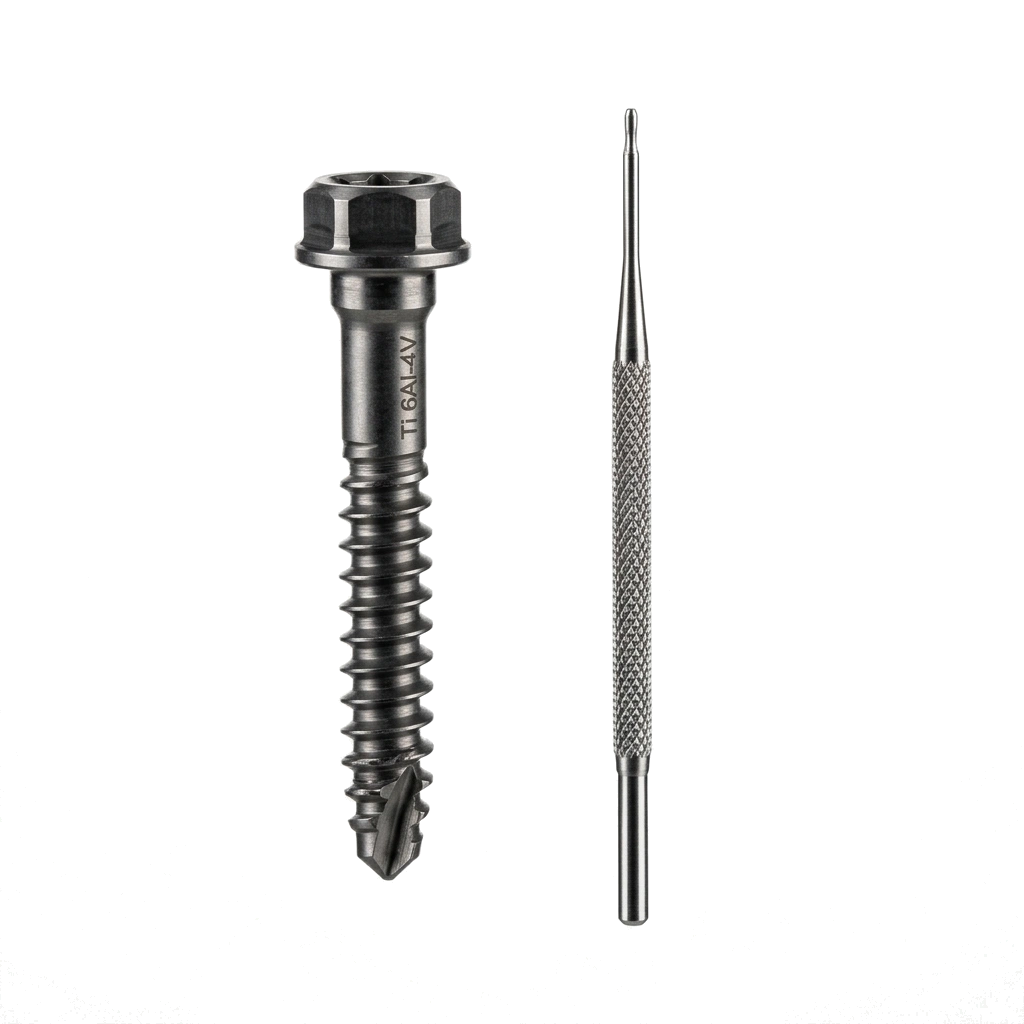
Precision turning of Titanium Ti-6Al-4V ELI bone screws, dental implant posts, orthopedic pins, and endoscope tips with ISO 13485 quality control.
Titanium & 316L medicalHigh-Volume Bar Fed Runs
Automated 12ft bar loaders, high-pressure coolant (2,000 PSI), and automated part catchers support fast production runs from 500 to 100,000+ pieces.
500 to 100,000+ pcs
Titanium Grade 5 Dental Implant Post & Bone Screw
Swiss turned for a medical device manufacturer requiring intricate thread geometry, micro-cannulation through-holes, and tight hex drive features. Machined in a single operation with zero hand deburring required.
tolerance held
surface finish
turnaround
2,500-piece run
- Optical comparator & CMM dimensional inspection report
- Mill test certs (EN 10204 3.1) with heat lot traceability
- Passivation certs per ASTM A967 / ASTM F86
- Certificate of Conformance per medical purchase order
Swiss Turning vs. Standard Lathe vs. CNC Milling
Choose the right manufacturing method based on geometry, tolerances, and batch size.
Stocked Materials for Swiss Turning
Precision ground round bar stock in metals, medical alloys, and engineering plastics.
Titanium Alloys
Ti-6Al-4V (Grade 5), Ti-6Al-4V ELI (Grade 23), Commercially Pure Titanium (Grade 2). Ideal for biocompatible implants, dental screws, and aerospace pins.
Stainless Steels
303, 304/304L, 316/316L, 17-4 PH, 440C, Custom 455. Excellent corrosion resistance, high tensile strength, and medical compliance.
Copper & Brass Alloys
C36000 Free-Cutting Brass, C17200 Beryllium Copper, Tellurium Copper C14500. Perfect for gold-plated electrical contacts and probe tips.
Specialty & Superalloys
Inconel 718, Kovar, Nitronic 60, Hastelloy C-276, Nitinol. High-temperature and controlled-expansion applications for aerospace and energy.
Medical Plastics
PEEK (Unfilled & 30% Glass Filled), Delrin (POM-H), PTFE (Teflon), Ultem 1000, Torlon 4203. Biocompatible, autoclavable, and dimensionally stable.
Alloy & Tool Steels
4140, 4340, A2, D2, M2 tool steel. High wear resistance and toughness after vacuum heat treating for mechanical shafts and dowels.
DFM Tips for Swiss Turned Parts
Optimize your 3D CAD models and drawings for maximum Swiss machining efficiency.
1. Precision Ground Bar Stock
Because the bar slides through a guide bushing, use h8 diameter tolerance precision ground bar stock to prevent binding or loose play.
2. Thread Relief Grooves
Provide a thread relief necking groove at thread shoulders (minimum 1.5x thread pitch) to allow clean single-point thread tool retraction.
3. Corner Radii & Chamfers
Specify internal corner radii of at least R 0.010" (0.25 mm) and external 45° lead-in chamfers to ease automated tool engagement and deburring.
How Durham Industries Use Swiss Turned Parts
Three local sectors, three very different turned parts. Here is what we machine for Durham teams.
Medical Devices & Diagnostics
Durham's device economy runs from BD's RTP infusion and injection operations to the trial pipeline at Duke University Medical Center, and its turned parts skew small, sharp and documented. RivCut Swiss machines bone screws, cannulated pins, luer fittings and dental implant bodies from 316L, titanium and PEEK, with concentricity held to 0.0002 inches TIR and material certs on every lot. Duke-Coulter teams bridging prototype to production keep the same process and the same inspection data from piece 1 to piece 10,000.
Semiconductor & Power Electronics
Wolfspeed's silicon carbide headquarters and IBM's advanced packaging research at RTP anchor a test and equipment ecosystem that lives on micro turned hardware. Probe pins, spring pin bodies, RF connector contacts, alignment dowels and vacuum fitting standoffs all fall inside Swiss lathe geometry, and most need burr free edges and cleanroom compatible packaging. We turn them from beryllium copper, brass, 303 stainless and Vespel, as machined finishes near Ra 16 microinches, and hold the ±0.0001 inch diameters that probe card work demands.
Robotics & Hardware Startups
Duke's robotics labs advance surgical robotics while Durham startups like Phononic build thermal management hardware, and both feed a steady prototype stream through American Underground and the broader RTP incubator scene. Surgical robot programs need slender linkage pins and precision shafts with ground quality bearing surfaces, and thermal hardware needs turned copper slugs and sensor housings. Swiss single setup machining with live tooling and a sub spindle finishes cross holes, flats and threads without a second operation, which keeps startup iteration loops inside a week of machining time.
Swiss Machining FAQ for Durham Buyers
Lead times, tolerances, materials and shipping for Durham orders.
Swiss Machining Near Durham
Need Swiss Turned Parts in Durham?
Upload your CAD file or drawing for instant pricing, guide bushing DFM feedback and fast delivery to Durham.